// Development · Web system
lanecodes.dev — Portfolio 2.0
My full-stack portfolio: bilingual website, custom API and admin panel.
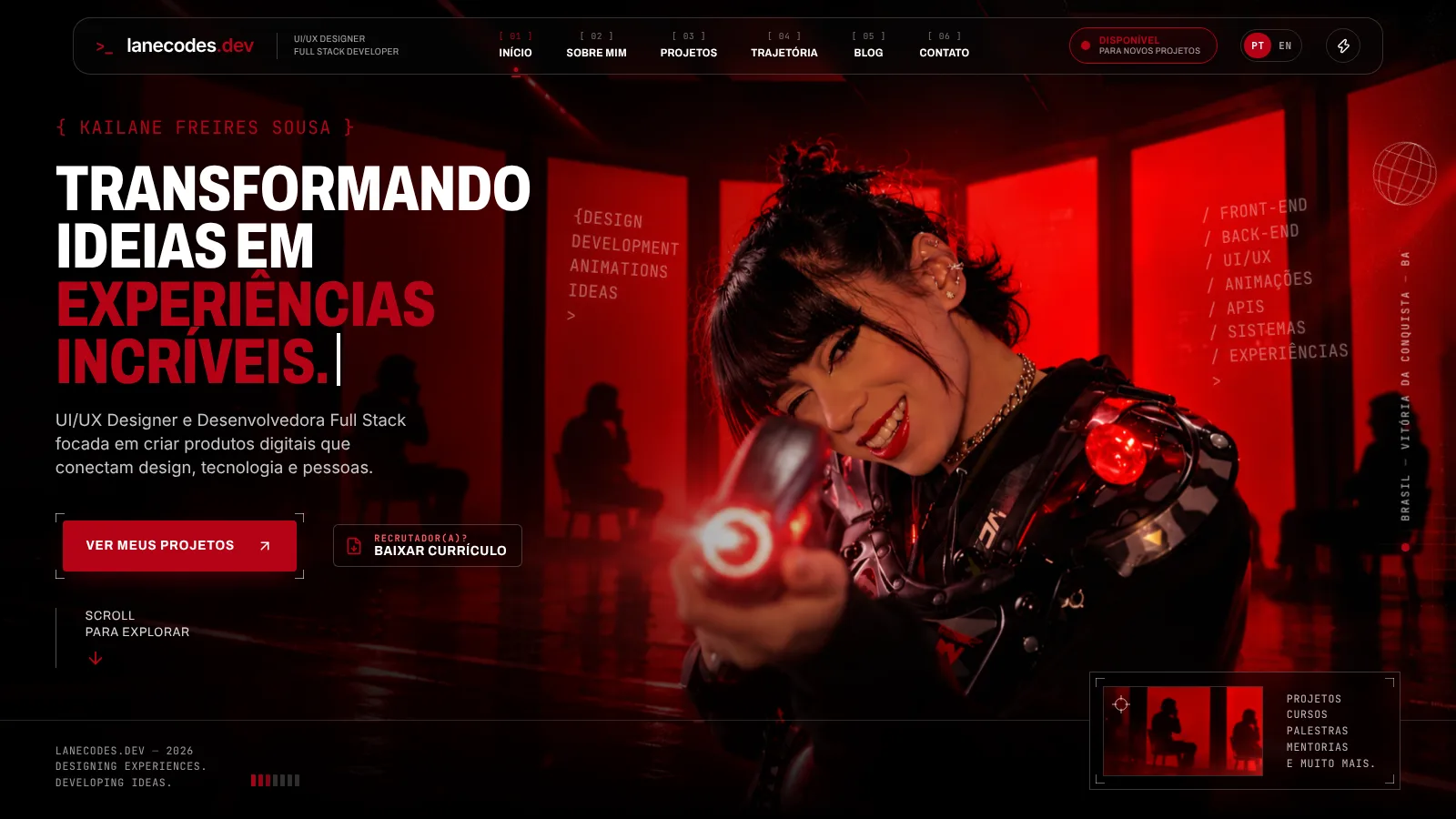
A personal portfolio I designed and built from scratch: a Next.js website full of interactive animations, a NestJS API with PostgreSQL and a Vue 3 admin panel to edit all content, in Portuguese and English, without touching code.
- client:
- 'Projeto pessoal',
- category:
- 'Web system',
- role:
- 'Design, full-stack development, animations, infrastructure and deploy.',
- year:
- '2026',
- stack:
- Vue.js 3QuasarReactNext.jsTypeScriptCSS3GSAPScrollTriggerNode.jsNestJSPostgreSQLPrismaFigmaViteGitDockerREST APIsJWT authenticationOpenAPI
The challenge
Building a portfolio that is itself proof of what I can do. Listing projects was not enough: the site had to show original design, animations that tell a story and a real product architecture, with a back-end, a database and an admin panel.
At the same time, everything had to be fast, accessible, easy to maintain and readable for recruiters in Brazil and abroad.
The solution
- Three separate applications: a public website in Next.js 15 + React 19, an API in NestJS 11 + Prisma + PostgreSQL and an admin panel in Vue 3 + Quasar.
- Single contract: Zod schemas in the API generate the OpenAPI spec, and both front-ends generate their TypeScript types from it.
- 100% editable content from the admin: profile, projects, services, process, stack, journey, talks, certificates and blog.
- Static site with on-demand updates: pages generated at build time and regenerated through tag-based revalidation whenever something changes in the admin.
- Bilingual (PT/EN) with
/enroutes, typed dictionaries and translated content from the API. - Original animations with GSAP, ScrollTrigger and Lenis, each with a reduced-motion version.
- PDF résumé generated on the server in Portuguese and English, always with current data.
Results
A portfolio live at lanecodes.dev that works as a complete product: original design, purposeful animations, editable content in two languages, automatic deploys on every push and a technical foundation that shows, in practice, how I think about front-end, back-end and experience.
Architecture
The system is split into three repositories that talk through a documented REST API.
- Website (Next.js 15, App Router, React 19): statically generated pages (SSG/ISR), a 1-hour cache and instant tag-based revalidation (
home,projects,project:<slug>,posts) whenever the admin saves something. - API (NestJS 11): domain modules, Zod validation, JWT authentication (15-minute access token) with a rotating refresh token in an
httpOnlycookie, Argon2 password hashing, rate limiting and Swagger docs. - Database (PostgreSQL + Prisma 6): 20 tables, versioned migrations and a JSON
translationscolumn for English content. - Admin (Vue 3 + Quasar + Pinia): sortable content forms, a Tiptap rich-text editor for the blog, image uploads and English fields side by side with Portuguese.
- Images converted to WebP with Sharp and stored on Cloudflare R2.
- Contact form with a styled email via Resend and an option to send straight to WhatsApp.
Animations and interactions
Every home section has an animation designed for the story it tells. Scroll-linked scenes use GSAP + ScrollTrigger, entrances and loops use CSS (@keyframes and animation-timeline: view()), and smooth scrolling is handled by Lenis.
- Terminal preloader: types
initializing lanecodes.dev, runs 5 steps with a spinner and ✓, a progress bar,build successfulandwelcome to my world_; a black and red curtain reveals the hero. It runs once per session and can be skipped with a click or any key. - Hero: title lines rise in sequence, a blinking cursor, a spinning globe and a scroll arrow; everything waits while the preloader runs.
- About: an editorial magazine layout with a headline, drop cap, columns, a duotone portrait and a fan of certificates.
- Manifesto: a pinned section where red lines rise and the text is "handwritten" with a mask and SVG stroke, synced to scroll (
pin). - What I do: cards with corner marks that enter as they appear, CSS only (
animation-timeline: view()). - Process: a serpentine flowchart; a red SVG connector is drawn by scrolling (
scrub) and lights up each step, with the "Approved?" decision and animated dashed "adjustments" and "new cycle" loops. - 100% responsive: a pinned, scrubbed timeline zooms into the monitor, turns the desktop layout into a phone layout, pulls back to reveal the device and ends with the battery draining at 1% and the screen going dark.
- Projects: on desktop, an IDE with a folder explorer, tabs and terminal; on mobile, a
scroll-snapcarousel of code-file style cards. - Stack: giant words drifting in the background, cards entering in sequence and an animated dashed rail linking patterns and integrations.
- Journey: a pinned section where scrolling walks the timeline and fills the red bar. Next to it, a physics badge: an elastic lanyard simulated with XPBD on canvas, a gentle idle sway, and visitors can pull, release and flip it (front and back with a QR code).
- Talks and blog: talks as tickets, "admission open" tapes running in the background and the latest post as a poster.
- Fireframe: the Fire + Frame equation slides in from the sides, the flame flickers and the cards spread on hover.
- Red bridges: every seam between dark sections has a gradient ellipse cut in half, one half in each section, forming a continuous glow down the page.
- Turn off animations: a header button and a preloader option save the preference, and a
<head>script applieshtml[data-motion='reduced']before the first paint. The site also respectsprefers-reduced-motion.
Performance and accessibility
- Only `transform` and `opacity` in animations, so they run on the GPU without layout recalculation.
- Centralized GSAP:
ScrollTrigger.config({ ignoreMobileResize: true })avoids recalculating when the mobile browser bar shows up, and pinned sections keep their progress on resize instead of jumping. - Every scene created in `gsap.context()` / `gsap.matchMedia()` and reverted when the component unmounts.
- WebP and AVIF images with
next/imageand self-hosted fonts. - Optional motion across the site: every animation has a static version.
- Bilingual SEO:
canonical,hreflang(pt-BR, en, x-default), a sitemap with both versions and per-page Open Graph. - Tested at 390, 768 and 1440 px, with dedicated mobile layouts where the desktop experience would not make sense.
Infrastructure and deploy
- Vercel: website and admin, with automatic deploys on every push to
main. - Render: NestJS API with migrations applied before each deploy (
prisma migrate deploy) and a health check. - Neon: managed PostgreSQL.
- Cloudflare: the
lanecodes.devdomain, DNS and images on R2, served frommedia.lanecodes.dev. - Resend: contact form emails.
- GitHub Actions: formatting, type checking and build on every push.
- PDF résumé generated on demand with
@react-pdf/renderer, with fonts and photo embedded so it works in a serverless environment.